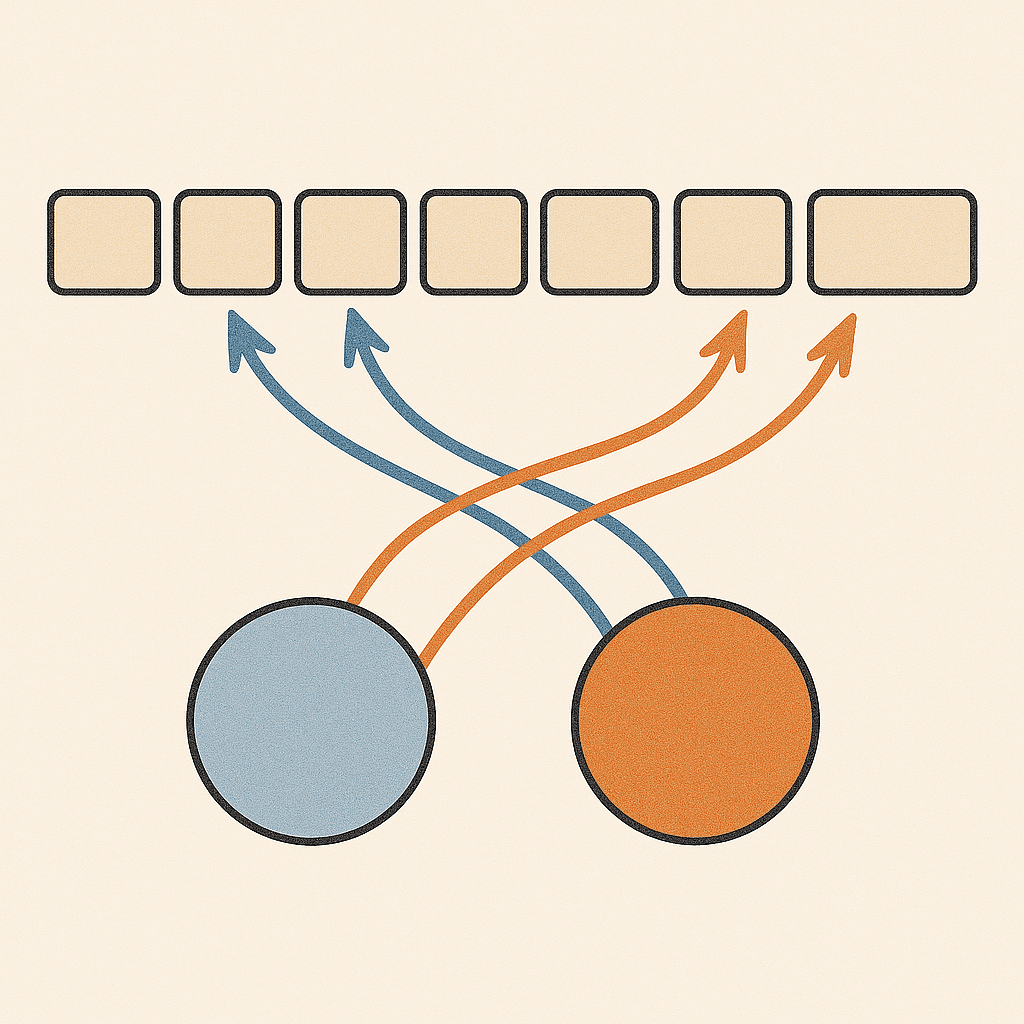
Understanding Sentences from Multiple Perspectives with Multi-Head Attention
Multi-Head Attention is a mechanism that runs multiple Self-Attention operations in parallel to better capture the different relationships in a sentence.
While a single Self-Attention layer can capture key word relationships, understanding complex contexts from only one perspective is often limited.
To solve this, multiple parallel Self-Attention layers were introduced, enabling the model to interpret the sentence from several viewpoints.
Example of Multi-Head Attention
Let's consider the sentence "The student is sitting at the desk reading a book."
Multi-Head Attention understands this sentence from various perspectives, such as:
-
Attention 1: Focusing on the relationship between
studentandsitting -
Attention 2: Focusing on the relationship between
bookandreading
Applying these multiple perspectives simultaneously helps Multi-Head Attention build a richer understanding of the sentence’s meaning.
How Does Multi-Head Attention Work?
-
The input sentence is duplicated and passed into multiple Self-Attention structures.
-
Each structure independently uses different weights to calculate relationships between the words.
-
The output from all structures is then combined.
-
Finally, this consolidated information is used to represent the sentence's meaning.
This process allows the model to incorporate diverse relational insights at once, producing a more accurate overall sentence representation.
Multi-Head Attention is a key component that enables Transformer models to understand sentences with greater precision.
In the next lesson, we'll apply what we've learned so far to solve a simple quiz.
What is the main function of multi-head attention?
Lecture
AI Tutor
Design
Upload
Notes
Favorites
Help